
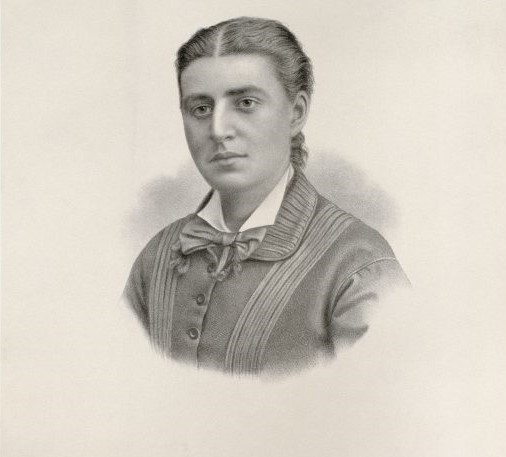
Adelaide Watt – photo from the National Trust
Back in the Hall, another well-informed staff member told me about Adelaide Watt, the Hall’s last owner, whose coming-of-age book is displayed in the room next to the gatehouse. Adelaide was the daughter of Richard Watt, who took over the Hall in 1795 after 250 years of Norris ownership. He made his money through sugar, rum and hardwood plantations in Jamaica, and, as was sadly common in those times, slaves. His family carried out numerous renovations and restorations to a building that had started to fall into disrepair, turning it into the Tudor mansion fitted with the Gothic Revival interiors – oak carvings, suits of armour, stained glass, tapestries, William Morris wallpaper, etc. – that I see today.
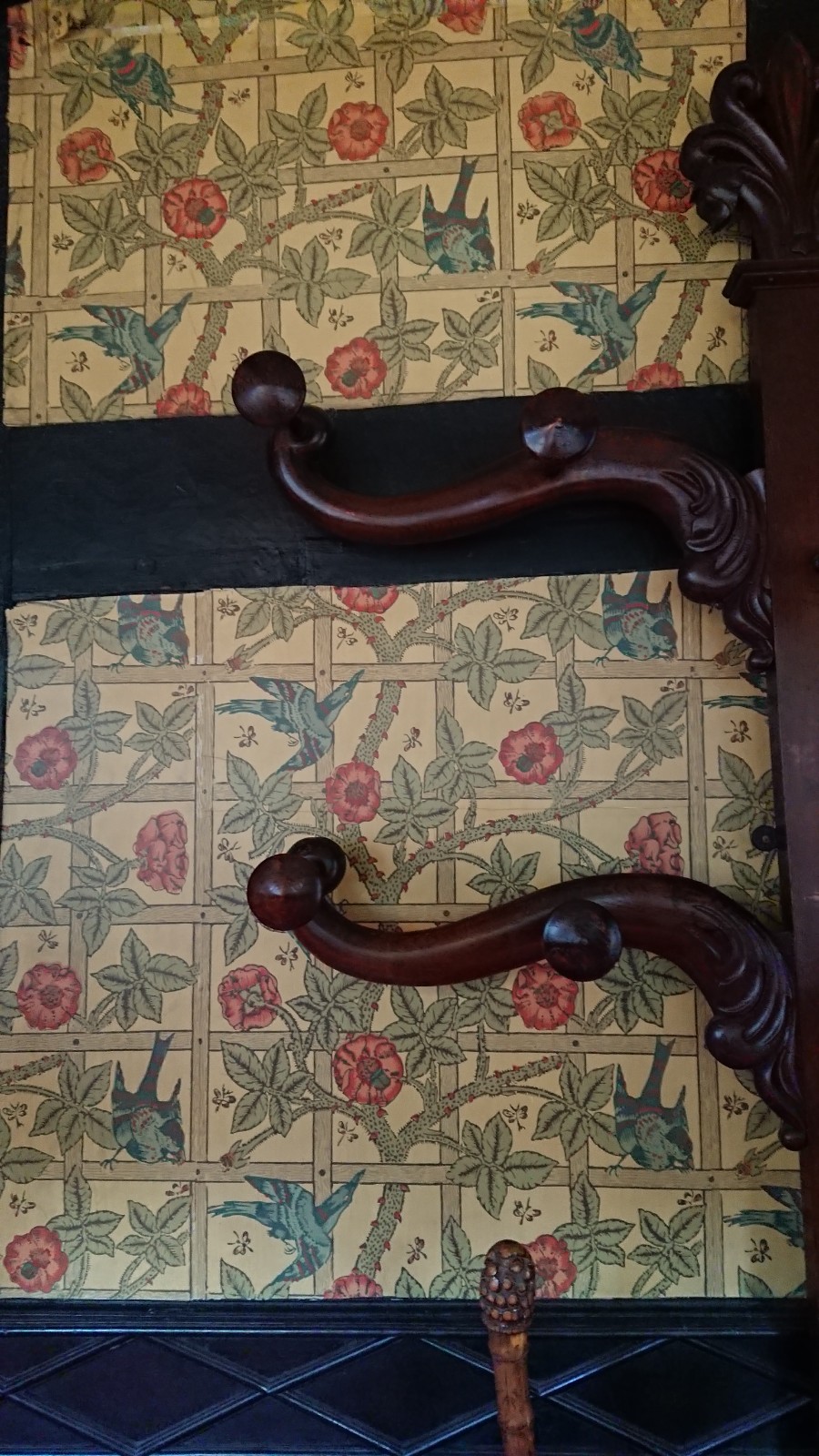
William Morris Trellis wallpaper
Leaving this room, I admire the wallpaper along the hallway, before reaching the Great Hall, with its striking portrait of the Childe of Hale, whom we have already come across in this blog. The painting is massive – a fitting tribute to the giant Childe.
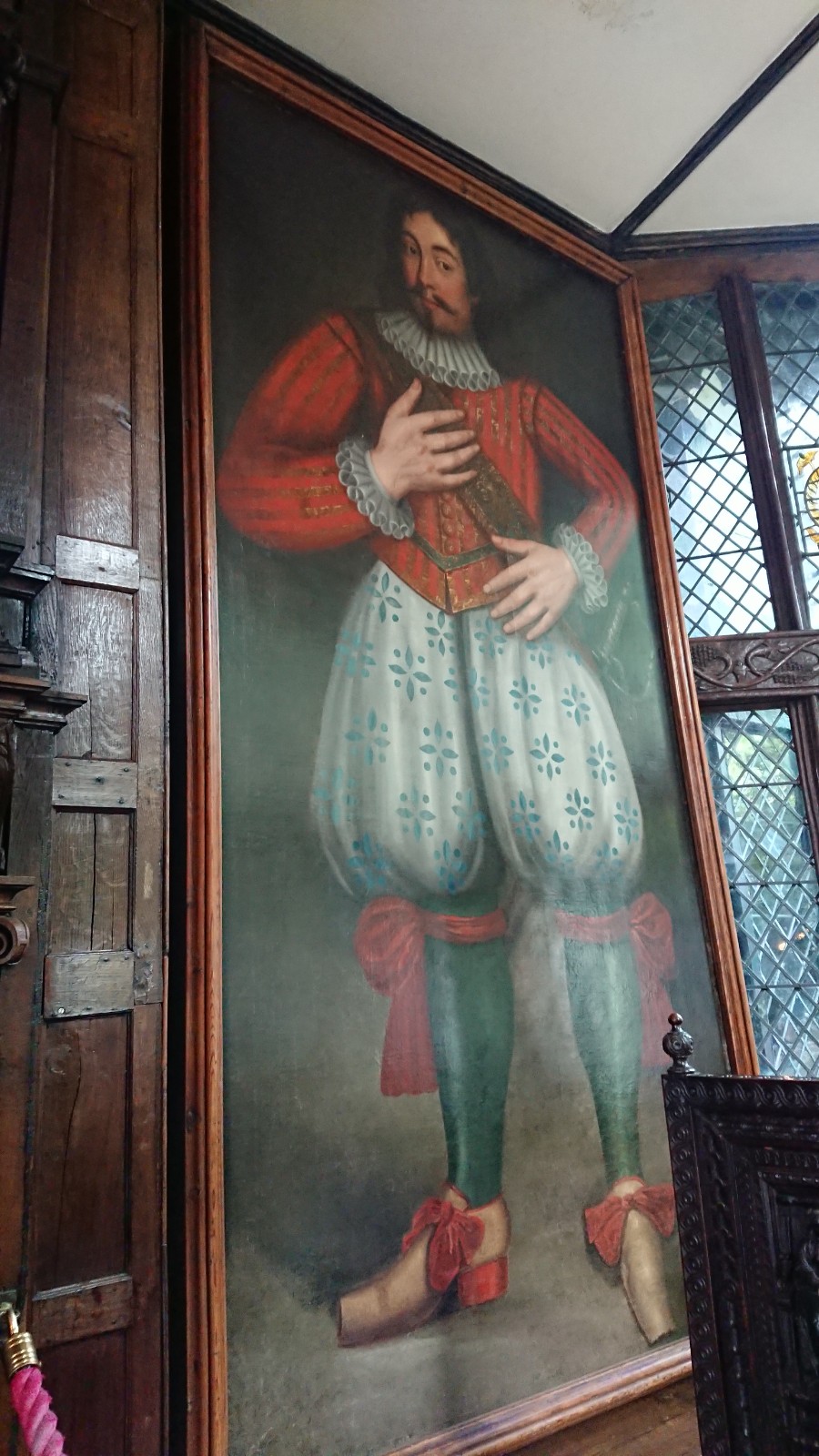
The Childe of Hale painting in the Great Hall
Looking down at the stone flagged floor, a number of fossils can be found, including what the National Trust’s website says is a Belemnite fossil from around 350-365 m years ago (when dinosaurs ruled the Earth!). More details about these incredible fossils can be found on the British Geological Survey website: https://www.bgs.ac.uk/discovering-geology/fossils-and-geological-time/belemnites/.
This ageing fossil then took herself upstairs, to have a look at the bedrooms. The main bedroom continues the ‘claustrophobically dark oak everywhere’ theme, with a heavy maroon counterpane on the four-poster bed adding to the Gothic feel. The two smaller bedrooms were slightly cheerier, with large tapestries and paintings alleviating the gloom somewhat, although the attendant in the bedroom that also contained a crib took great relish in telling the (apocryphal) tale of a mother hurling her baby out of the window… I moved on quickly, peering briefly through the spy hole, and into the final bedroom, its colourful counterpane a cheery counterbalance to what had gone before.
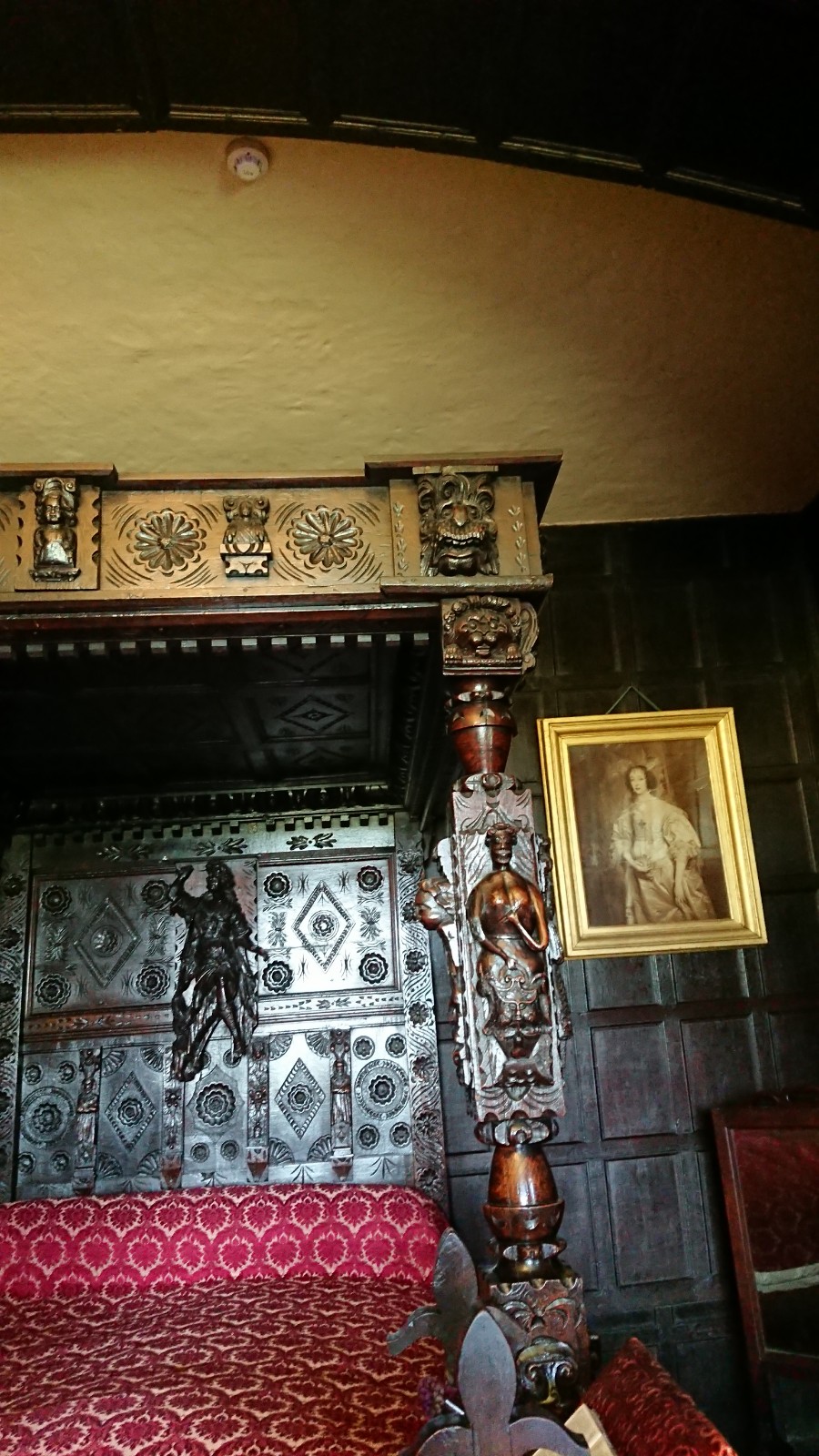
Dark oak panelling and four-poster bed – with lion heads – in the main bedroom
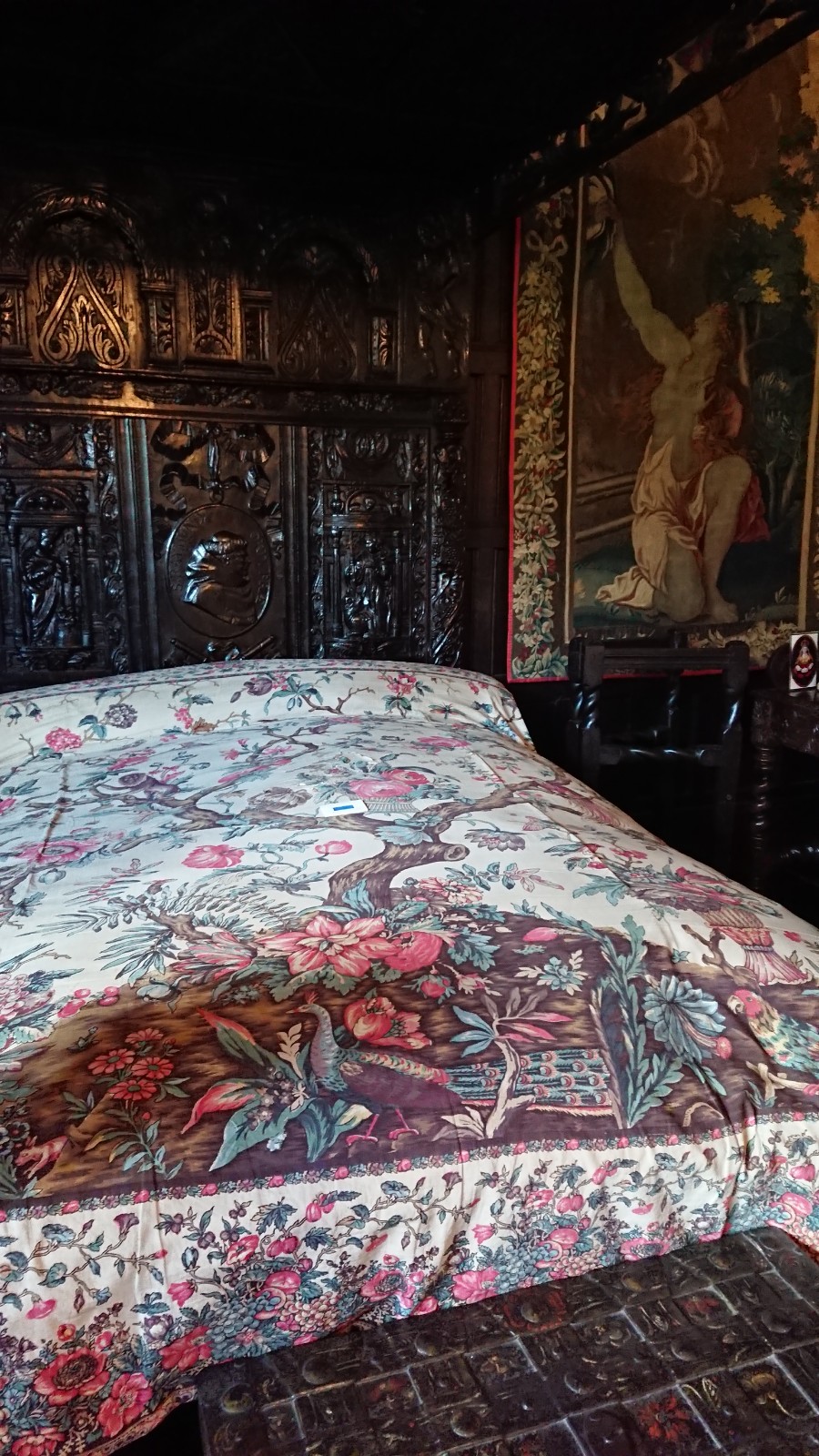
The smaller bedroom
Downstairs, it was a relief to enter the kitchen, a large, airy room, with a stone flagged floor, and a scrubbed wooden table at its centre, and utensils including copper pans hanging from the walls. Outside, there is a small dove cote – brick-built with spaces for the birds to roost and nest. A helpful notice explained that the doves and pigeons kept here would have been bred to eat, as their meat was considered a tasty delicacy in Tudor times. There would also have been fish in the moat and pond – which is an attractive, lily-pad-filled feature a little further on from North Lawn – and more taken available from the Mersey Estuary just a few minutes’ walk away.
After a stroll around South Lawn, with its formal, tree-lined paths, I headed for the woodland walk up to the Bund, where I spent a pleasant half an hour in the sunshine, looking over the estuary. The hedgerows were full of deep pink hawthorn berries, the purple-black sloes of the blackthorn, and bright orange rose hips. Descending towards the house again, I saw a large wooden book inviting readers onto the Childe of Hale’s trail, so, curiosity piqued, I followed a winding path through a small woodland, coming across a huge pair of shoes, and a small cottage with a pair of (shoeless) feet sticking out of the window. The air was rent with the sound of tremendous snores, and I knew that I’d found the Childe abed! I tiptoed past, not wishing to awaken him, noticing what looked like a ha-ha nearby, and emerged back onto South Lawn, ready to exit through the gift shop – or the bookshop, actually, as Speke Hall has a very well-stocked second-hand bookshop.
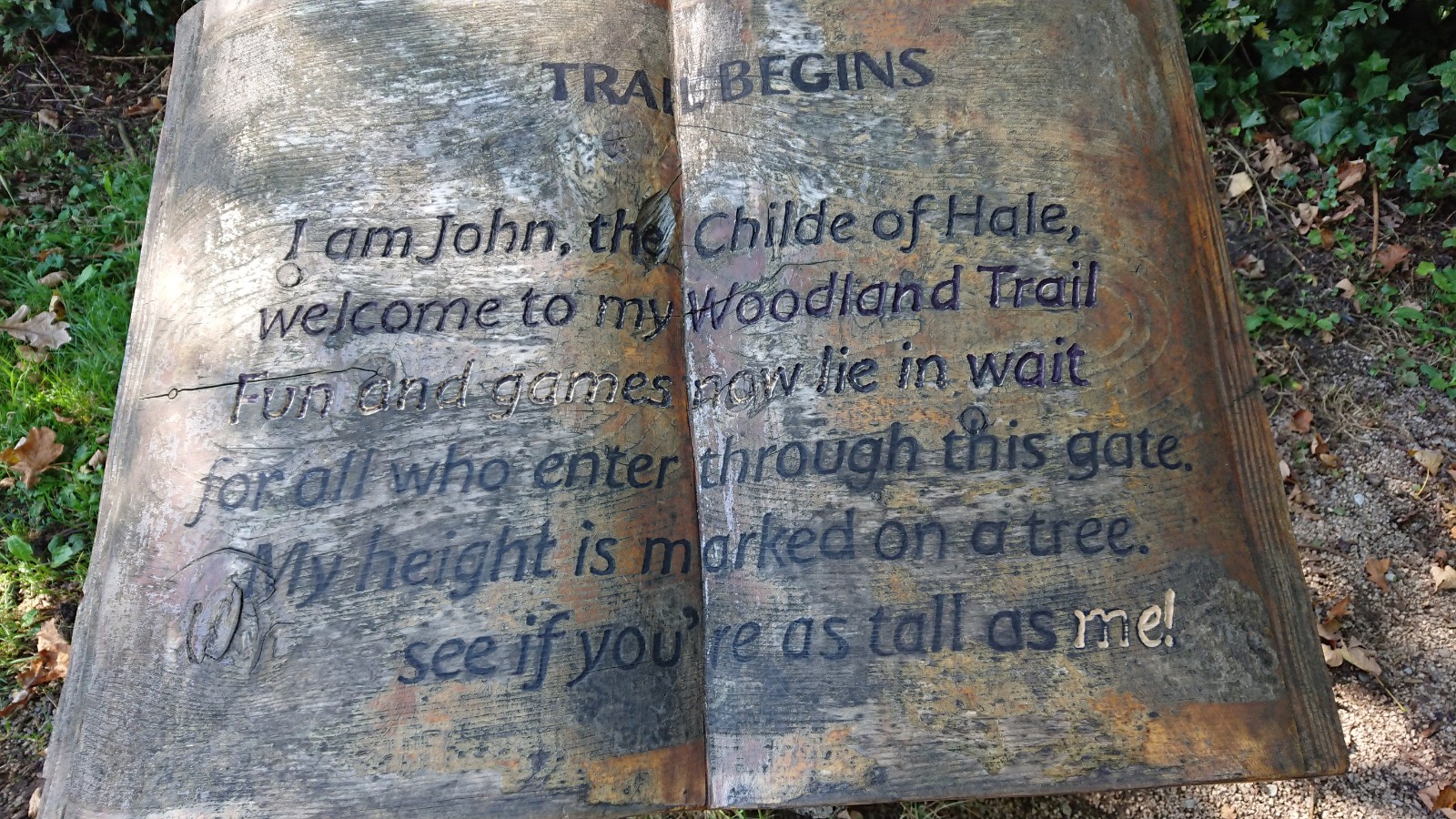
Book at the beginning of the Childe of Hale trail
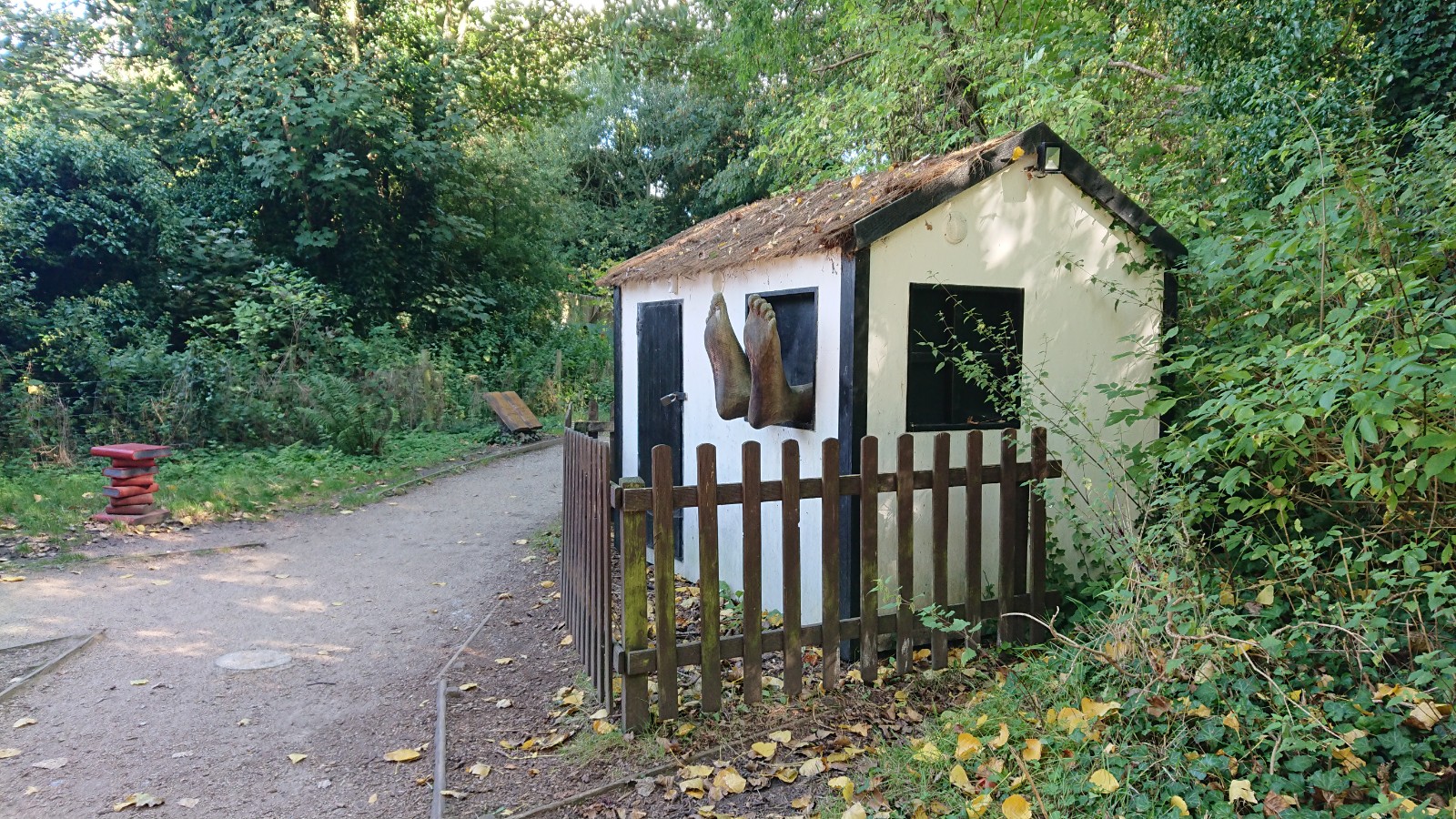
The Childe asleep in his cottage
A fantastic couple of hours at a property that is central to Liverpool’s history. It is lucky that Adelaide Watt had the foresight to want to preserve Speke Hall for posterity, as well as modernising it, and to bequeath it to the National Trust (see the NT website for more details about the site: https://www.nationaltrust.org.uk/speke-hall-garden-and-estate).