
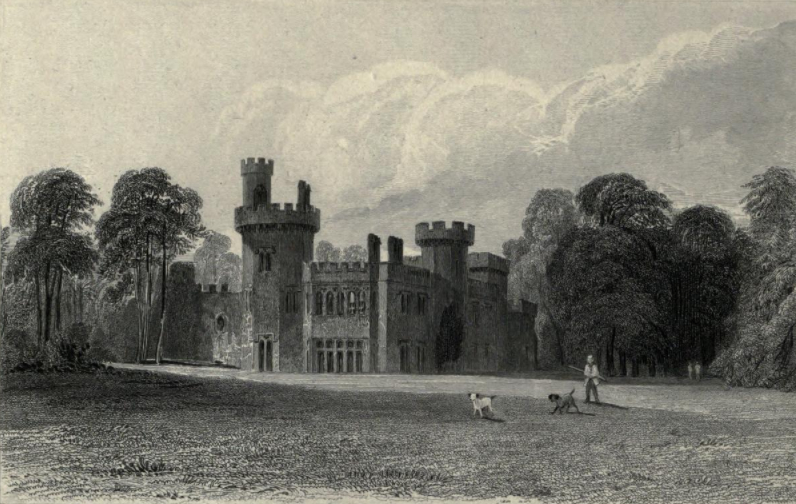
Childwall Hall from a drawing published in Lancashire Illustrated 1832 – Thomas Allen, Public domain, via Wikimedia Commons
It’s another hot, sunny August day, with barely a cloud in the sky or a breeze rustling the leaves, and a large group of people has gathered at Childwall Woods, this time for a history walk with Brenda and other FCWF members. It was a fascinating couple of hours, complete with interesting details about the history of the land, the manor and the people who had lived there over the last 300 years.
As we know from previous posts, Childwall Woods used to be heathland. Around 300 years ago, a Liverpool lawyer called Isaac Greene bought the manor house and decided he wanted a more impressive stately home with a formal garden including nut trees, and also a hunting wood (the Black Woods). I found it surprising that he had been able to pass this all down to his daughter Mary – even though he had three daughters and no sons – because I thought women couldn’t inherit property that long ago, so well done Isaac! Mary married Bamber Gascoyne (no, not that one) and they had a son, also called Bamber, who decided to renovate the property, calling on the services of John Nash to do so. Nash also designed the main lodge, which still stands today, on Childwall Abbey Road, marking the main entrance to the woods.
We started our walk by heading along the carriageway, which has been given a complete clean up and is now a pleasure to stroll along, dwarfed by the impressive Bunter sandstone walls on either side. We were ankle-deep (slight exaggeration) in leaves in places – which were falling early due to the stress of July’s intense heatwave. We marvelled at how much work and effort must have gone into cutting 12ft down into the sandstone to create the carriageway. Because of this activity, which exposed the years of sedimentary laydown, the carriageway is a regionally important geological site. The mud was cleared out down to the crumbling rock, which was probably originally put down for drainage, and passing places were built into the walls.

The carriageway
Reaching the end of the carriageway, we unfortunately did not emerge onto a view of the hall, because that no longer exists; when Liverpool City Council bought it in 1939, intending to use it as a college, they found that it was riddled with dry rot, and so it had to be demolished.
So here we stand, expectant but hall-less… but Brenda has a surprise in store… which we will get to in Part 2.