
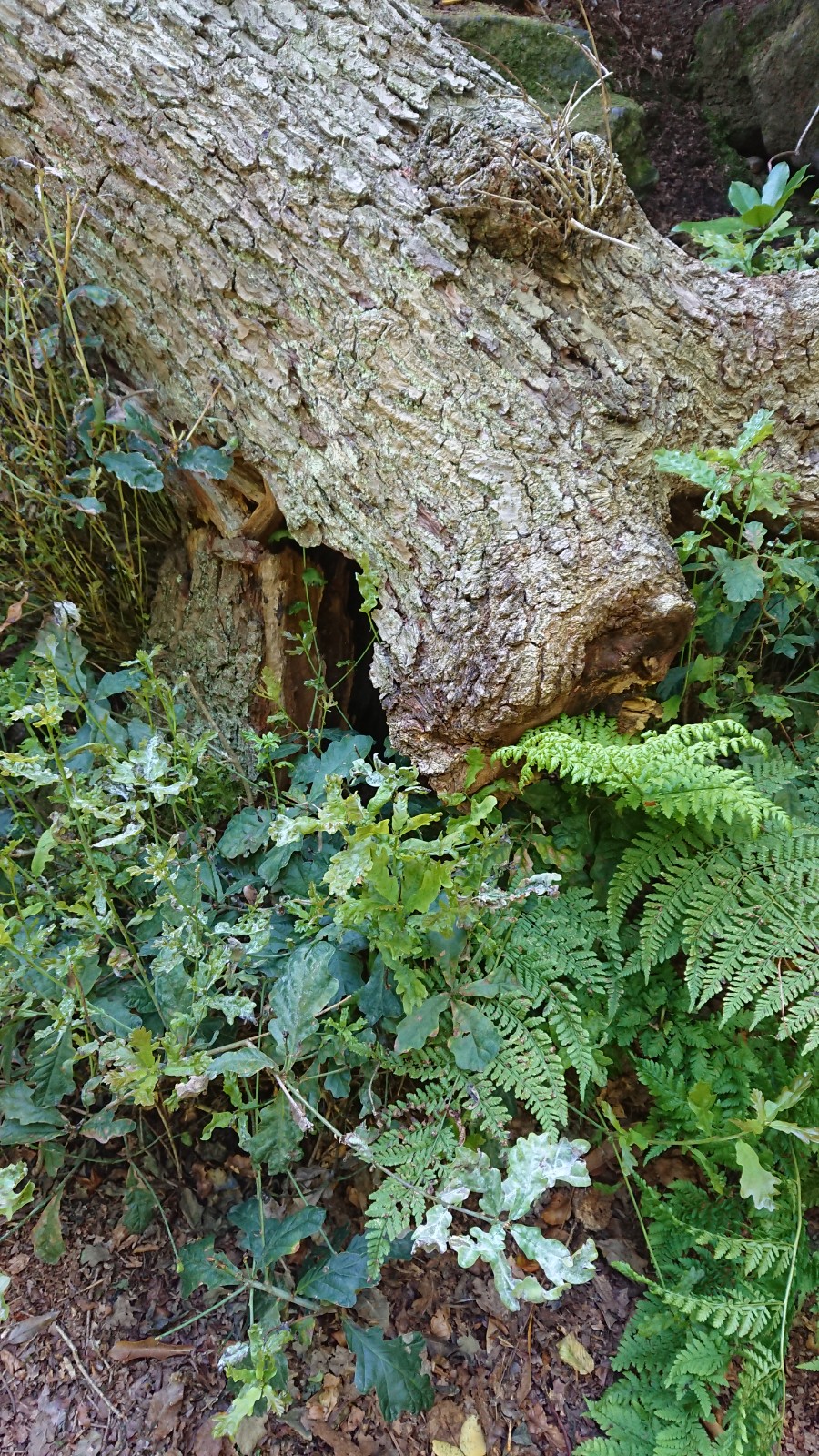
Variegated oak
On our absorbing walk through Childwall Woods, we are next introduced to an extremely rare specimen: a variegated oak, one of only two in Lancashire (both in this woods) and less than 70 in the UK. It had been blown down in a storm but new growth was appearing – a few green and white leaves. Brenda explained that Thomas Winkthorpe, one-time head gardener, had grafted a ‘normal’ oak tree and an albino one to produce this hybrid specimen (more here: https://www.fcwf.org.uk/the-champion-tree/).
Staying with the oak theme, we carried on to a burnt holm oak at ‘Monkey Island’. Although vandalised, it was still growing and providing shade in the small amphitheatre-type space. Fascinating whorls had formed on one of its surfaces, the tree’s reaction, we were told, to the stress of being burned. It was surprising to learn that oaks are ‘promiscuous’ and that this species is the result of a match between an oak and a holly!
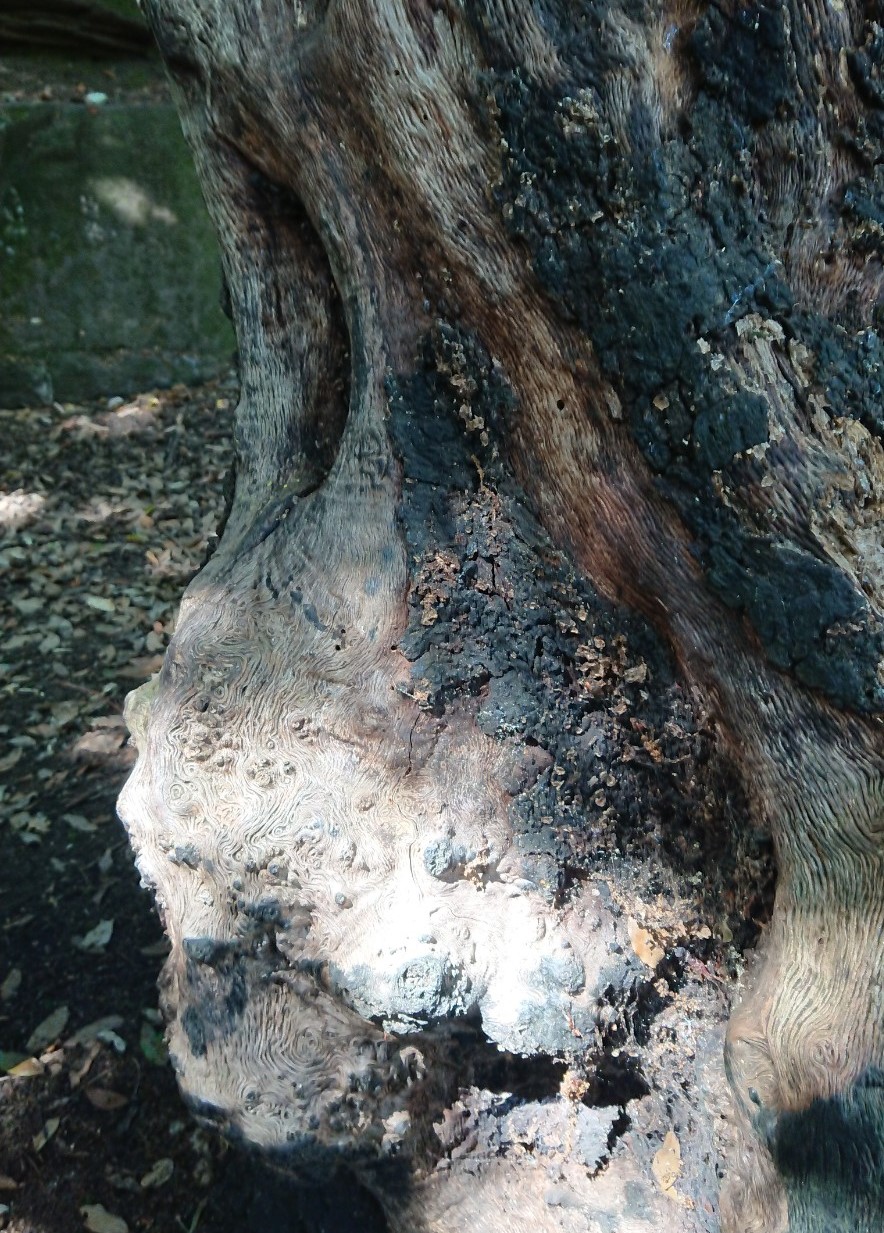
Tree whorls
Visiting another veteran, Brenda told us the remarkable tale of how in May this year she had found a species of fruit fly that is probably new to the UK, just from observing it on a bracket fungus on this particular tree, being interested enough to take some photos of it, and sending these to an entomologist friend who put her in touch with a ‘fly specialist’. A couple of specimens later, and he was able to confirm that it was a species not previously reported in the UK – apart from a couple of possible sightings down south. One wonders what else is lurking unnoticed and undocumented all around us and, as trees and fungi have very useful medicinal properties, we need more people taking an interest in these spaces and species. As an example: the sweet chestnut has a very strong immune system which is good at repelling fungi and insects. Folklore is full of its medicinal uses, such as for treating coughs and breathing problems, and now medical science is finding that the bark has antioxidant and possible cardio-protective properties.
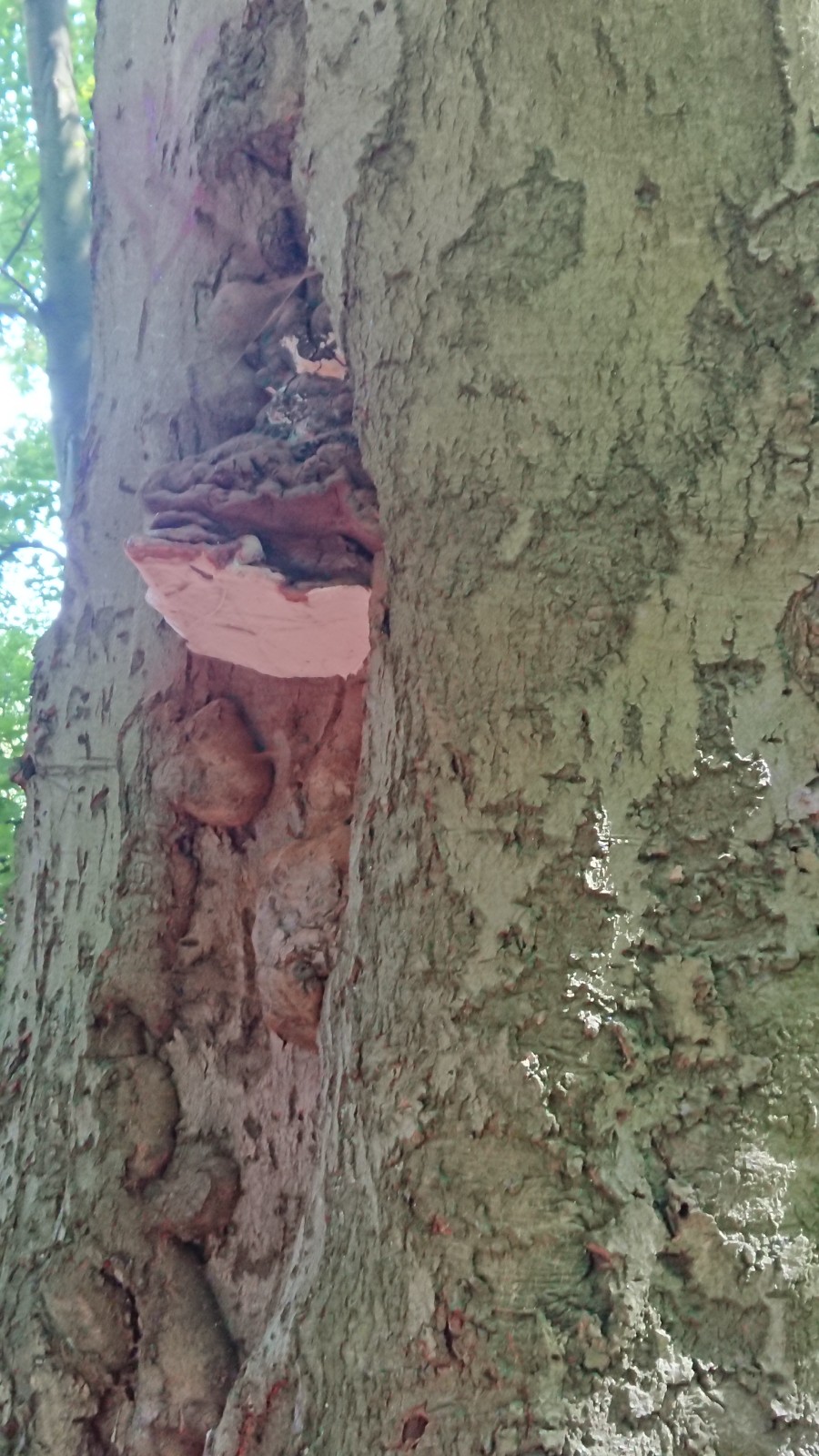
The fruit flies’ favourite – bracket fungus
As you no doubt know from biology classes, trees swop their sugary sap with fungi that give them nitrogen and phosphate in a symbiotic relationship. But did you know that different trees have a relationship with different fungi? Or that fungi have great healing and other medicinal qualities? For example, turkey tail fungus is licensed in Japan for use in breast cancer treatment; split gill is a very rare fungus with anti-inflammatory properties (although, if it gets in the lungs, it can cause breathing issues).
Unfortunately, the fascinating walk had gone on well past its scheduled timespan, and I had to leave – but the Friends group has a fantastic website (https://www.fcwf.org.uk/) packed full of details about the woods and the history of the place. Luckily, Brenda had mentioned that she was leading a history walk the next day, so I immediately signed up for that…